Back
  1. Mumbai Move: Rethinking Urban Mobility and Social Entrepreneurship

    March 7, 2026 by Ben B. and Liam F.

    Location: Mumbai, India | Term: Winter 2026

    Navonmesa Module Driving Question

    How might Mumbai’s community-driven systems inspire more sustainable urban living?

    The Challenge

    Mumbai’s congestion is more than a nuisance; it’s a crisis. Residents lose nearly half their personal time to traffic, and the resulting air pollution contributes to hundreds of deaths annually. With 19% of the population occupying 82% of the road space in private vehicles, the city’s productivity and safety are at a breaking point.

    The Solution: Mumbai Move

    Liam and Benjamin developed Mumbai Move, a service-exchange app designed to shift commuters from private cars to public transit.

    • How it Works: The app tracks bus and train journeys via Google Maps integration.
    • The Incentive: Users earn points based on mileage and time spent on public transport, redeemable for discounts at local businesses.
    • Impact: By gamifying sustainable travel, the project aims to reduce four-wheeled vehicle traffic by 10% and provide real-time carbon emission tracking for every user.

    Field Research & Inspiration

    The project was fueled by immersive experiences across Mumbai:

    • Dharavi: The team explored the “slum’s” $2 billion circular economy, learning how total resource efficiency and community interconnectedness can drive massive impact.
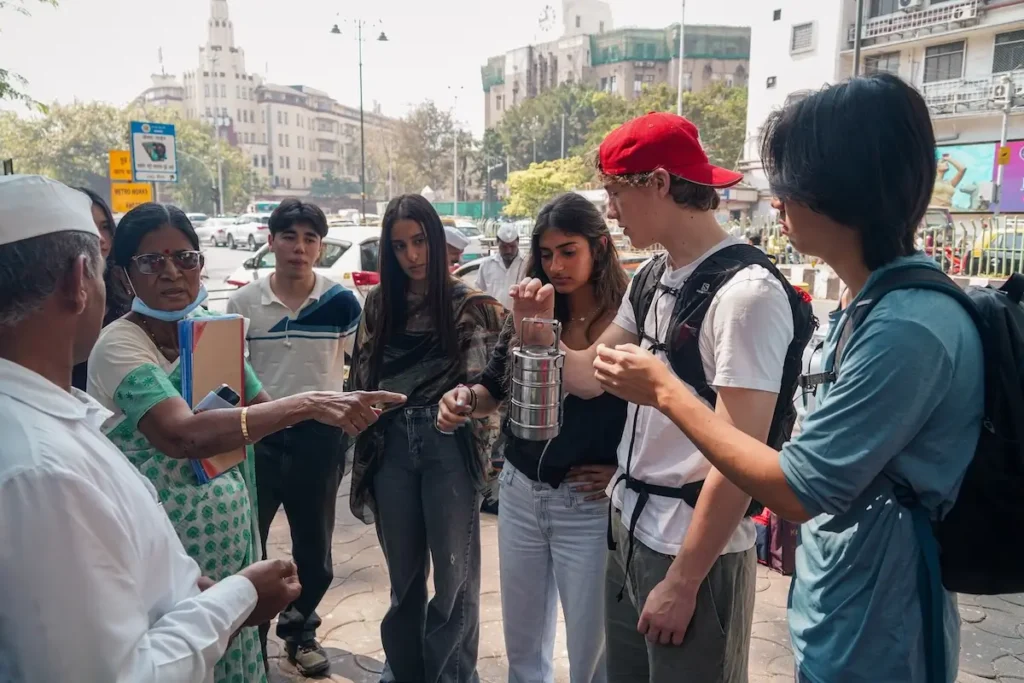
    • Dabbawalas: Studying the legendary lunch-delivery system provided a masterclass in logistics, loyalty, and near-perfect operational efficiency.
    Final Product: The ENpower Pitch

    The term culminated in a professional startup pitch (Navonmesa) delivered to industry mentors.

    • The Assessment: The duo presented a full business model, including a tiered subscription service (Standard and Pro+) and a B2B advertising strategy.
    • Refinement: Based on expert feedback, the final iteration focused on a “powerful” user hook and a clear bridge between transit data and consumer rewards, ensuring the business was both socially responsible and financially viable.
  2. Narrative of Life

    December 10, 2024 by Teacher-Led Module

    Driving Question:

    How can we use multimedia literary expression to tell the story of conservation of biodiversity in Brazil?

    Module Summary:

    The teacher-led module “Narrative of Life” explores how storytelling can be used to communicate the importance of biodiversity conservation in Brazil. Guided by the driving question, how can we use multimedia literary pieces to tell the story of conservation of biodiversity in Brazil, students investigate environmental issues through creative expression, combining research with artistic interpretation to raise awareness about human impact on nature.

    Throughout the module, students participate in a range of field experiences, workshops, and expert-led sessions that deepen their understanding of conservation and storytelling. Learners engage with professionals such as an agroforestry project leader, take part in poetry and vocal workshops, and join a boat expedition with a marine bioacoustics expert. A key highlight of the module is a week spent in the Amazon, where students gain firsthand insight into biodiversity and conservation efforts, supported by local organizations and experts.

    In their final projects, students create immersive multimedia literary pieces that communicate environmental narratives in creative ways. These projects include performances, writing, and audiovisual storytelling that aim to inspire awareness and action. For example, students present works such as a song that personifies nature to highlight the impact of human exploitation, using artistic expression to convey complex environmental issues. Through this interdisciplinary approach, the module emphasizes the power of storytelling in driving meaningful change and fostering a deeper connection to the natural world.

  3. Emergency Box

    September 12, 2024 by Maya G.

    Driving Question:

    How can I contribute to solving a problem in my local community?

    Project Summary:

    The Service Project “Emergency Box” focuses on improving emergency preparedness in the Township of Georgian Bay, Ontario, where many residents live far from hospitals and first responders. Through this project, Maya G. examines how remote communities face increased risks during medical emergencies due to long response times and limited access to life-saving equipment.

    In this project, Maya G. investigates how the lack of nearby emergency services can lead to higher risks of fatalities and long-term health complications. Her proposed solution is the installation of community emergency boxes containing critical first-aid equipment such as an AED (defibrillator), EpiPens, naloxone for drug overdoses, snake bite kits, and other medical supplies. Maya has already taken concrete steps toward implementing this solution by writing and presenting a motion to the Township of Georgian Bay council, which has passed its first round of approval and is currently under review by staff.

    A key component of the project is ensuring that these emergency boxes are strategically placed and accessible, with the first proposed location near Gibson Lake, where both road-access and water-access cottages could reach the equipment within minutes. Maya also emphasizes the importance of public awareness and education, explaining that community members must know where the boxes are located and how to use the equipment. Her long-term goal is to expand the initiative to more lakes across the township and potentially throughout Ontario, improving emergency response in remote communities.

  4. Defining Art

    January 27, 2022 by Keetah B.

    Art is such a big part of Oaxaca’s culture and its diversity is what makes it so unique. We had the chance to talk to artists who make art for a living, and it has been in their family for 5 generations. We also had the chance to talk to newer artists who may not depend on it for an income. It has been a very interesting experience to take in all the different perspectives of these artists, and learn about how they all coexist in the same place.

    -Class of 2024 Student Keetah B..

    Driving Question: How might we convey the intersection of local arts and economy through documentary filmmaking?

    What were your goals for this module? How did you achieve them?

    During the AyAyAyAyAy module, my goals were to improve my filmography skills while gaining an in-depth understanding of art and economy here in Oaxaca.

    Through this module, we were filming and editing for hours at a time, so I improved my filmography skills through constant practice and analyzing what I did wrong and how I could improve it. We also got feedback from local videographers, which was very useful when using Premiere Pro for the first time.

    During both the weXplore and back at the main residence, the experiential learning really helped me feel like I understood Oaxacan art. We even got to take part in making the art and talk to the artists. I now have a greater understanding of the relationship between art and economy, art and politics, and art and culture. I feel that I have also learned about how vital artisanship is here and the perspective more modern artists have of artisans.

    What new things did you learn about yourself?

    I learned more about my filming style and what I can improve on when filming. I also learned that I’m a perfectionist, especially when it comes to editing.

    I learned that my perspectives of what art is and the motivations people have for art don’t always align. I also learned how people’s perspectives of art itself might change depending on why they do art.

  5. Beyond a Canvas Project

    by Kiana B., Camille A., Kirsten A.

    Driving Question: How might we convey the intersection of local arts and economy through documentary filmmaking?

    What were your goals for this module? How did you achieve them?

    To inform others about local artists in Oaxaca relating to art and the economy. 

    What new things did you learn about yourself?

    Throughout this module, we learned multiple different things: From how art and economy in Oaxaca are changing to learning how to edit and film our very own documentary. This module also tested our limits, as it was very demanding no matter how interesting, and we can say that we are very proud of our final result.

    What are your big takeaway lessons from this project?

    Our biggest takeaway is how the art industry has evolved here and how that impacts the artists here in Oaxaca, and how there is more openness to expressing oneself through art.

  6. Accelerating the Circular Economy in Queretaro, Mexico

    June 9, 2021 by Isa Moro Luna

    Driving Question: How can I raise awareness and facilitate alternative solutions to food waste and loss in Mexico?

    Project Overview: For her service project, CM2 Student Isa Luna Moro set out to facilitate a circular economy system to reduce food waste inside Queretaro’s food industry. To do so, she worked with local restaurant Moser to improve their sustainability practices and contribute to the circular economy through techniques such as composting and recycling.

    Project Reflection: ““My service learning project was a journey of exploration, creativity, and boldness. During this project I decided to go out of my comfort zone and take one of my passions to the next level. I was able to improve my leadership, communication and self-confidence.”

  7. Exploring Water Scarcity and Safety in Honduras

    February 26, 2021 by Estelle W.

    Driving Question: How can I address some of the present threats to global health while promoting human rights and social progress?

    Project Overview: In this module, students were introduced to the foundations of global health. They learned about basic concepts, measurements, and determinants of health, and a number of key perspectives for considering global health issues.

    For her project, Estelle explored water scarcity in Honduras, which leads to a lack of basic sanitation and clean water for up to 1.8 million people. Non-communicable diseases in Honduras attributed to water cause a DALY rate of 4,540 per 100,000 people. Disease spreads through contaminated food and water tanks, and poor management, climate change, and political unrest worsen the issue.

    Project Reflection: “Exploring the niche of environmental global health opened my mind to so many new areas of interest in this field.  I thoroughly enjoyed this module and felt like the skills will be very applicable to other modules.”

  8. Sustainably Scrumptious

    January 13, 2021 by Ella M.

    Driving Question: How can I incorporate more local and homemade food into my diet to improve my sustainability and health?

    Project Description:

    My project is a short book of recipes I have written myself that use local, sustainable, and healthy ingredients. To write these recipes, I looked at foods I eat most often and local foods I have access to decide on the items before researching the history of each item and the different methods used to make them so I could create my own recipes. I also researched how a recipe is written, how to cater to your intended audience, the proper language to use, and the elements to include. My final product is a collection of these recipes that could be used by relatively new cooks.

    Reflection:

    “This project was especially interesting because I have done a lot of cooking and baking in my life, but I have never been one to follow recipes. Doing this project and creating my own recipes really helped me understand how recipes can be useful as well as how much work and effort goes into making each one. I think I will now be at least slightly more inclined to follow recipes when cooking in the future.”

  9. Food, Culture, Action

    October 13, 2020 by Marily M.

    Driving Question: What are the unique properties of a meal/dish from my culture and how can I share that with the world?

    Project Description: This module was about exploring my culture and highlighting our unique characteristics. They could be from language or family to religion and traditions. I was looking for a dish that is important to me and represents a big part of my culture. My final product for the project is a video explaining the importance of my dish, pan de muerto, and how to do it step by step.

    Project Reflection: “I enjoyed learned about my culture and the origin of many of my traditions. Baking pan de muerto and recording the process was challenging and exciting at the same time. I learned how to communicate in a simple and interesting way.” -Marily

  10. Tackling Malaria in the Democratic Republic of Congo

    by Sofia V.

    Driving Question: How can I address some of the present threats to global health while promoting human rights and social progress?

    Project Description: My project is a policy brief about the Malaria situation in Congo. It includes its nature and magnitude, the most affected populations, the socio-economic consequences, and the potential solution to reduce the burden. The policy aims to convince the finance Minister of Congo to invest in solutions for Malaria.

    Project Reflection: “I enjoyed hearing from my peers how the health care systems function in different countries. A challenge was writing in the concise and precise way required for the policy brief.” -Sofia W.

Sign up if you would like to receive occasional news from us.

Subscribe