Driving Question: How can I make a farm-to-table egg delivery service become a viable business in a suburban community?
What did you take away from this project? I learned that perseverance is very important in order to get the end result you want. When I thought I was done and then realized there was something that bugged me in my video I made sure to take the time and fix it. This was very frustrating at times but in the end I was very happy and confident with my proposal.
What are you most proud of? I’m most proud of the extremely useful life skills I learned throughout this process….and that I made $485 of total income.
Driving Question: How can I use music to have a powerful impact on a multicultural audience, making them realise they are not alone in the mental challenges they often face.
Project Description: Through my mastery project, I wanted to evoke emotions that have rarely been evoked in a listener through a song, to make them realise that they are not alone in the problem they face.
After listening to a song, the listener should think something like, “Wow, I never thought someone else would be going through the exact same thing” or “I can’t believe that someone else found this problem and I have been experiencing all my life but never recognized as a problem.” It’s a mix between a call for action and recognition.
If one person tells me they were in a tough spot in their lives and that my music helped them get through that, I know I’ll have accomplished something.
Driving Question: How do local people feel about tourism and environmental regulations in Puerto Galera?
Project Description: A couple of months ago, our family went on a trip to an island in the Philippines called Puerto Galera, so my sister and I decided to film a short documentary. It’s our little passion project to spread awareness on unsustainable tourism in the Philippines. We wanted it to highlight the unique perspectives of four local residents we got the opportunity to spend time with. Hopefully, it gives justice to an island that we and our entire family love.
What were your goals for this project? We wanted our documentary to inspire a call to action on unsustainable tourism. The effects of unsustainable tourism can cause an entire island to shut down, resulting in thousands of people losing their livelihoods. By interviewing the residents of Puerto Galera, we want to show our audience the people that are directly affected by this issue, which will hopefully create a sense of urgency to protect our environment.
What were your takeaways from the project? Working on the project reminded me of how unbelievable our world could be. I was reminded of how important it was to make sure that we sustain the beauty of our environment, especially in a small country like the Philippines. This project was a big wake up call for me and I hope that it can be the same to our audience.
Driving Question: How can I acquire deep knowledge on Buddhist philosophies and their perspectives on the self and the world by working with monks and creating an original short film?
Project Description: My film introduces the Korean tradition of Zen Buddhism and its view on how to live a good life.
What were your goals for this project? My goal was to gain deep level of understanding on Buddhism, living it, and sharing it with others. I achieved all of these as I spent significant amount of time studying the text of Buddhism, living as Buddhist at a temple, and filming what I have learned to share with the world.
What were your learning takeaways? I’ve learned that suffering comes from trying to perceive impermanent thing as permanent and unchangeable. This includes my sense of self, my life, values, things I cherish at the moment… etc These are not something solid. They are very much fluid, temporary concepts and consists of myriads of components which forms and alters them. Accepting that, and staying thoroughly present, instead of trying so hard to extend the lifespan of these fleeting concepts, will lead to a more fulfilling life.
What are you most proud of? Experiencing even for a short amount of time, the freedom of not needing anything. Happiness to just be.
Driving Question: How can I build a modern recurve bow with the available materials in Panama City and be able to explain the physics behind archery in a simplified way to my audience during showcase?
Project Overview: I have been practicing archery since 2016 and my passion for archery never stopped after joining TGS.
During the Panama term, after finding out about the opportunities the “Fab Lab” (fabrication lab) offered, I couldn’t miss the chance to build and design my own bow. With Educator Dan Garvey’s help I was able to make the “skeleton” of a recurve bow and understand some basics of wood working and lamination.
While working on the project I faced many challenges. The first try of making the bow failed because the wood strips were too thick, so Dan and I made thinner wood strips and experimented with it until the lamination of the bow succeeded. I learnt so much out of this passion project, from real life application of geometrical translations in planes, scaling, wood working to patience and learning how not to give up when something doesn’t succeed during the first try.
Driving Question:How can I create an eco-friendly product and brand?
Project Description: For this project, I used the design cycle to formulate my own shampoo bars. I also constructed a business factsheet, SWOT analysis, and pricing strategy. With the findings from my market research paper, I created a buyer persona, social media pages and a website to effectively reach my target audience.
Project Reflection: GreenCare was my year-long passion project. I started it because I saw a gap in the current market for green products. Many green brands were only targeting people that could afford a price premium; however, I have always felt that in order for us to make a macro-level shift to conscious consumerism, everyone, regardless of economic background, should have access to sustainable products.
That’s when I came up with GreenCare—a green beauty brand that values inclusivity and sustainability. The entire process has been an amazing (and stressful) learning experience. From the beginning, I quickly realized that I wanted to make shampoo bars because of their potential impact on the sachet market. I also knew I wanted to formulate my own bars to understand my product inside and out. As I continued, however, I soon realized that this would be more difficult than I had thought. In total, it took about four months, many failed attempts, and weird periods of greasy hair to get to a formulation that I was happy with.
To achieve my science A.I. learning target, I researched the biochemistry behind hair and design specifications extensively. I spent days in the kitchen mixing surfactants with essential oils, colorants, and fatty alcohols. After each testing trial, I would ask my family for feedback on my bar so I could improve the next. I failed probably 95% of the time. My bars were always either too dry, too oily, or disintegrated in the bathroom after the first use. It felt hopeless. Nothing worked. I worried that it never would. Then one day, it did.
After analyzing past formulations, finding trends and making conclusions, I finally figured it out. After about eight trials, I discovered a decent formulation for my bars—one that was sulfate-free and had the right ratios to clean hair without drying it. It also stayed intact even after using it for the first time. I felt ecstatic! My mom and sister approved as well. My bars performed all the qualities of shampoo (cleansing and smelling nice) while being completely zero-waste. They’re definitely what I’m most proud of for this project. The biggest takeaway from this project was the lesson of positive risk-taking.
At TGS, risk-taking is a skill defined as “the willingness to make mistakes, advocate unconventional or unpopular positions, or tackle extremely challenging problems without obvious solutions, such that one’s personal growth, integrity, or accomplishments are enhanced”. Through GreenCare, I tackled the extremely challenging problem of formulating my own product. I had to learn that failing was okay. No. Actually, it’s essential. Without those eight attempts, I would have never gotten to the place where I am now. In hindsight, I’m grateful for all those times when I thought of giving up because they make this entire journey so much more fulfilling. Now, I’m not saying that this is the end. In fact, it’s far from it. I know that my entire life will be a collection of failed trials and attempts. But if there’s anything I’ve learned from GreenCare, it’s that the occasional successes make it all worth it.
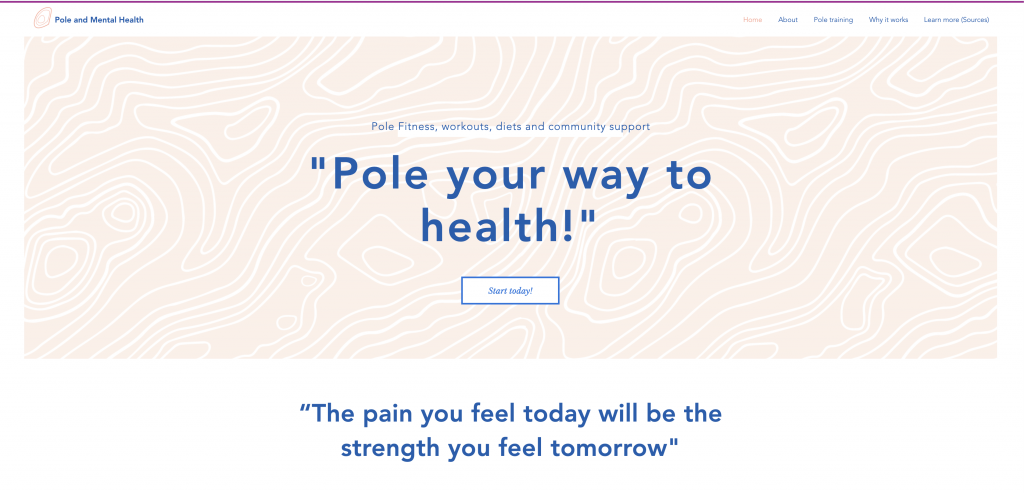
Driving Question: How can we take lessons from the sports industry to better improve the health of a specific group in need?
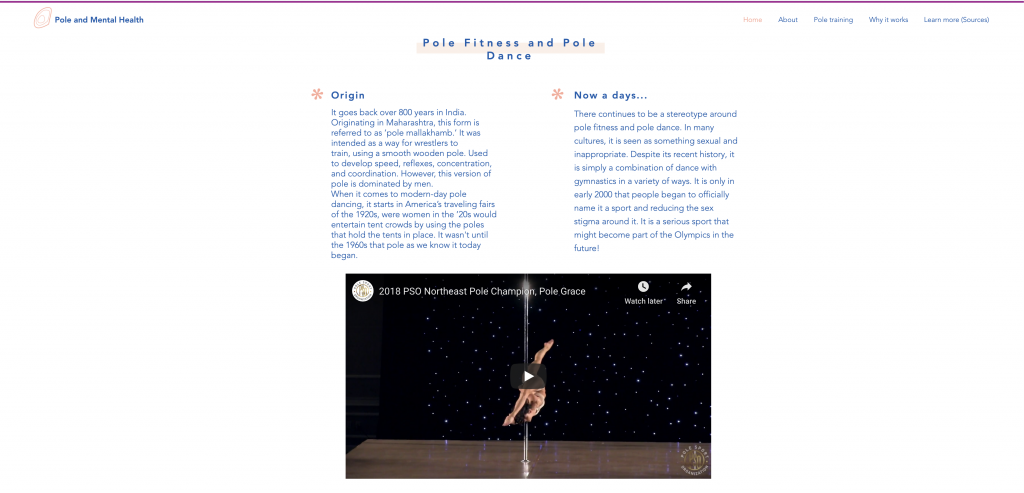
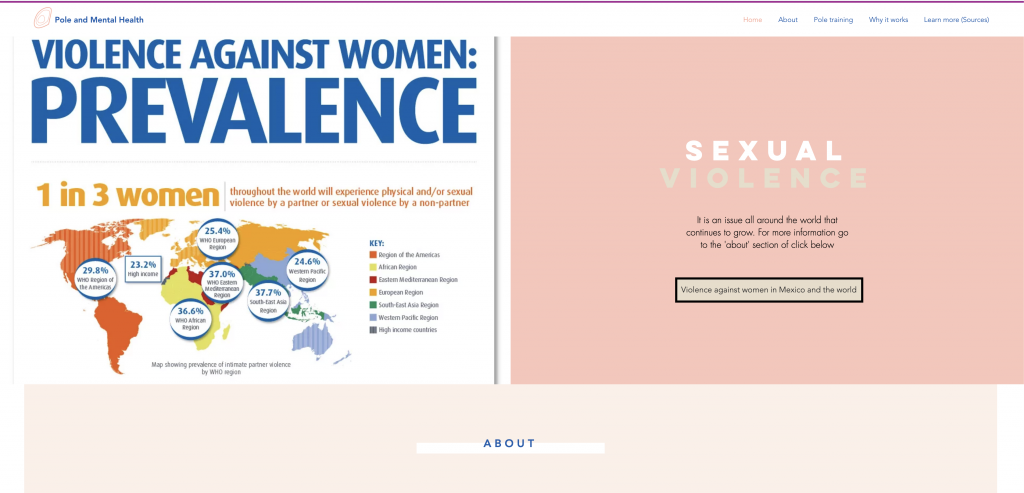
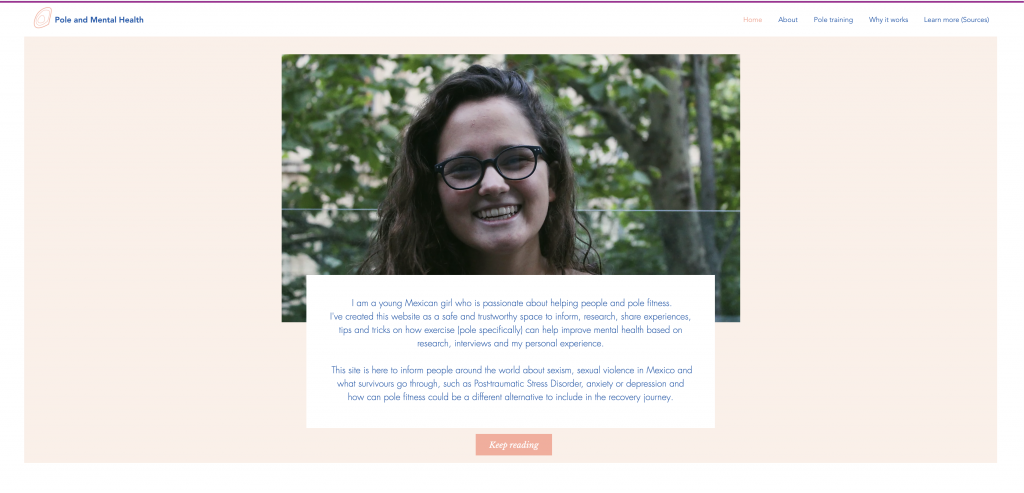
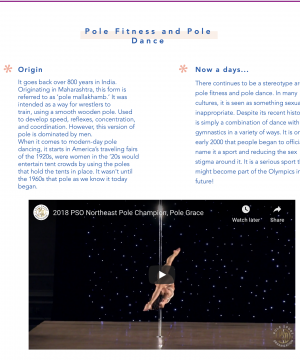
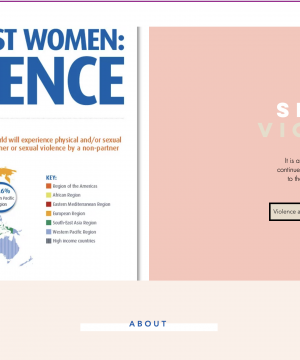
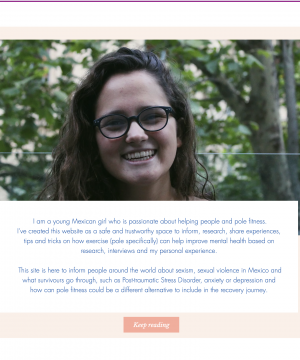
Project Description: My goal for this module and term was to understand the effects of exercise in mental health and experience them myself. I also wanted to bring awareness to some “taboo” topics and defeat the stigma around them: gender violence (focusing on sexual violence), mental health, and pole dancing. I asked myself, “How can I apply what I learn about elite athletes to the females in my community who have experienced assault or harassment and could use exercise to improve their mental health, self-confidence and wellbeing?”
To answer this I made a website that is easy to navigate, gives a “safe vibe” and shares reliable information and resources.
What did you learn about yourself or about your creative process or about your medium? I learned a lot about myself, the culture I grew up in, and the global perspective of it. From how to do such an incredible sport like pole fitness and gain confidence and strength from it, building a community in the studio I learned at, and learning from strangers who then became friends.
I learned to take a deeper look into where these issues root from, why shame is related to them, and how I can make a difference in my community.
I learned the power and strength I have when I trust myself and how to transmit that to others. All the issues this summative addressed are quite complex and I learned how to balance them, support my claims, and share why I am passionate about such issues and this sport and project.
It also changed the way I see fitness. I now see it as more of a balance between mental and physical health and exercise (mindfulness and physically).
Driving Question: How can I use a video format to effectively communicate the many facets of the LGBTQ+ community to someone who knows nothing about it?
Project Description: This project is a 5-part video series explaining the LGBTQ+ community for a beginner audience. The intention of these videos is to be a resource for anybody who would like some more information on the community. You can find all five videos below.
Driving Question: How can I organize a trash clean up event in my community to positively impact the environment?
Project Overview:
I’ve seen the forest back at home gone through all types of natural and unnatural transformations. Every time I visit, there is a trail of evidence that demonstrates the presence of humans. I think it is extremely important to address the relevance and impact of maintaining these spaces clean. Especially when it comes to a natural reserve that is filled with flora and fauna. My project, Por un Lago Azul, is the beginning of a Trash Clean Up campaign in my community that aims to provide spaces and tools to facilitate reflection. I wanted to organize a clean up event that had a meaningful value for the community that could also meet academic needs.
Driving Question: How can I use webcomic style art to convey a message about mental health during quarantine?
Project Description: Daydream During Quarantine is a short story about a girl getting lost in her garden while thinking about her future, her goals and life in general.
What were your goals for this project? I really wanted to grow both my digital art and Japanese skills. Through this project I was able to grow both.
What were your takeaways from the project? Digital art is hard for beginners! I would really like to continue working towards making more digital art and bettering my technique in general.