Back
  1. Emergency Box

    September 12, 2024 by Maya G.

    Driving Question:

    How can I contribute to solving a problem in my local community?

    Project Summary:

    The Service Project “Emergency Box” focuses on improving emergency preparedness in the Township of Georgian Bay, Ontario, where many residents live far from hospitals and first responders. Through this project, Maya G. examines how remote communities face increased risks during medical emergencies due to long response times and limited access to life-saving equipment.

    In this project, Maya G. investigates how the lack of nearby emergency services can lead to higher risks of fatalities and long-term health complications. Her proposed solution is the installation of community emergency boxes containing critical first-aid equipment such as an AED (defibrillator), EpiPens, naloxone for drug overdoses, snake bite kits, and other medical supplies. Maya has already taken concrete steps toward implementing this solution by writing and presenting a motion to the Township of Georgian Bay council, which has passed its first round of approval and is currently under review by staff.

    A key component of the project is ensuring that these emergency boxes are strategically placed and accessible, with the first proposed location near Gibson Lake, where both road-access and water-access cottages could reach the equipment within minutes. Maya also emphasizes the importance of public awareness and education, explaining that community members must know where the boxes are located and how to use the equipment. Her long-term goal is to expand the initiative to more lakes across the township and potentially throughout Ontario, improving emergency response in remote communities.
  2. Quake Quest

    by Teacher-Led Module

    Driving Question:

    How can we improve earthquakes preparedness in Vancouver through collaboration and innovation?

    Module Summary:

    The teacher-led module “Quake Quest” explores the science, history, and societal impact of earthquakes in Vancouver and the surrounding region. Guided by the driving question, how can we improve earthquake preparedness in Vancouver through collaboration and innovation, students investigate the risks associated with seismic activity and the strategies communities use to prepare for and respond to natural disasters. The module emphasizes interdisciplinary learning, combining science, mathematics, history, and technology to better understand earthquake preparedness.

    Throughout the module, students learn from guest speakers, field experiences, and hands-on investigations that deepen their understanding of earthquakes and disaster response. Students explore Indigenous knowledge through stories such as the Thunderbird and Whale, which help explain natural phenomena and preserve historical records of seismic events. They also receive training in emergency preparedness from Christine Bodnarchuk of the BC Earthquake Alliance, learning essential safety practices such as “Drop, Cover, and Hold On.” Additional speakers introduce topics including search-and-rescue operations with trained dogs, artificial intelligence in disaster response, and the role of satellite data in detecting ground movement after earthquakes.

    Students also participate in experiential learning opportunities, including visits to local geological landmarks along the Sea-to-Sky corridor and the Museum of Anthropology, where they explore both the geological causes of earthquakes and their cultural and historical impacts. In their final assessments, students apply their learning by creating tabletop games that incorporate earthquake science and probability concepts, as well as developing AI-based proposals aimed at improving earthquake preparedness, response, and recovery. Through these projects, students demonstrate how collaboration, technology, and education can help communities better prepare for future seismic events.

  3. Mo-Botics Module

    January 28, 2022 by Bido H. Luiza M. Santiago D. and Noemie T.

    Getting into the field of robotics with little hardware knowledge was both challenging and exciting. I learned that I can find ways to implement existing knowledge into a new field and that there’s always room to lead my own learning experience if I work hard enough. My biggest takeaway is always approaching any new project with a positive, open, and flexible mindset.

    -Class of 2023 Student Bido H.

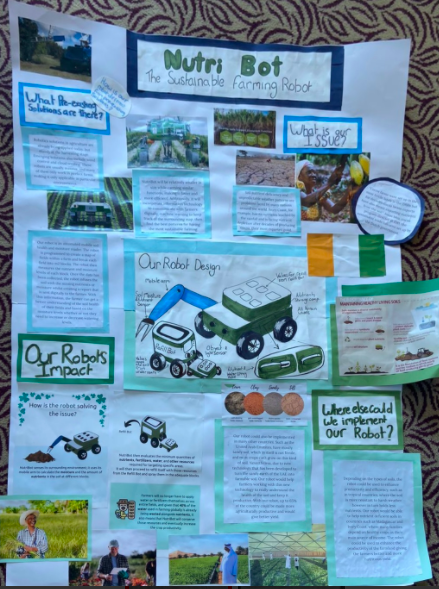
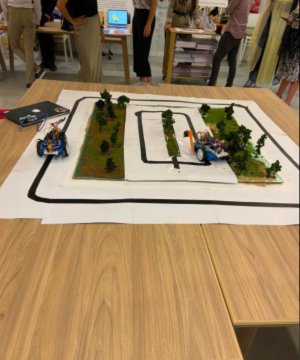
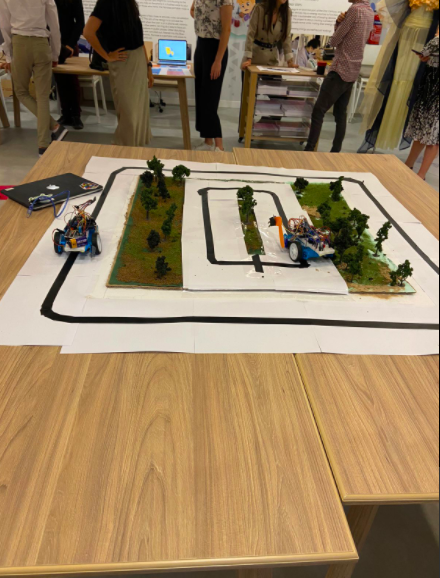
    Driving Question: How can I design and build a robot – inspired by Expo 2020 and the Mobility Pavilion – that performs an action to increase our quality of life?

    Our project is an autonomous conservational technology system that aims to provide efficiency in agriculture. NutriBot goes around agricultural fields and senses its surrounding environment to measure moisture levels and the type of nutrients in the soil. It then uses this data to evaluate the minimum quantities of water and nutrients necessary to keep the soil healthy and sprays them in the targeted blocks. Implementing this system will make farmers no longer have to apply water or fertilizers across entire fields. NutriBot can conserve up to 40% of water already wasted in agriculture alongside nutrients due to human error and inefficiency.

Sign up if you would like to receive occasional news from us.

Subscribe