Back
  1. Reimagining the Saree in India

    March 17, 2026 by Bernice M.

    Location: Mumbai, India | Term: 2025-2026

    The Driving Question

    How can traditional garments be reimagined through the merging of innovation and contemporary ethics with a deep-rooted history and culture?

    The Project: The Umushanana-Saree Fusion

    In response to the driving question, Bernice developed a bespoke saree design that acts as a cultural bridge between Indian textile tradition and her own Rwandan heritage.

    • The Design Goal: Working from a hypothetical client brief, Bernice sought to design a garment that felt “effortless and modern.” The result was a fusion concept inspired by the Rwandan Umushanana, reimagining the saree as a global garment suitable for high-profile celebrations like Rwandan weddings.
    • Innovation & Ethics: Her design process prioritized “slow fashion” ethics, researching sustainable materials like Tussar silk and examining how digital looms and CAD programs can modernize production without losing the “sacred geometry” of hand-drawn motifs.
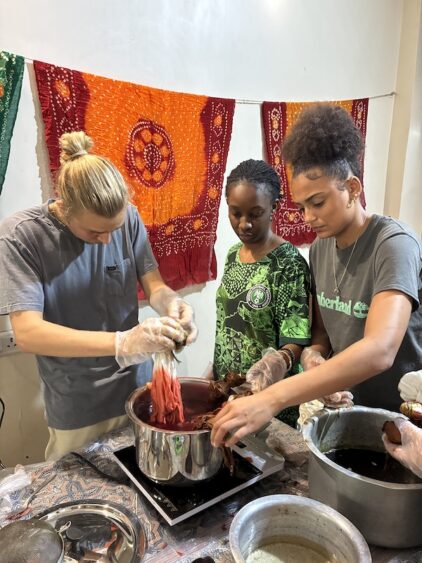
    Mastering the pinch: A close-up look at the precision required for Bandhani tie-dyeing, where small sections of fabric are bound to resist dye and create intricate patterns.

    Field Research & Immersive Learning

    To ground her design in “deep-rooted history,” Bernice engaged in extensive field research throughout Mumbai:

    • Sacred Geometry: By studying the Kanheri Caves and the Global Vipassana Pagoda, Bernice analyzed ancient architectural patterns—such as the Flower of Life—and translated those spiritual symbols into contemporary textile motifs.
    • Radical Resourcefulness: An excursion to the Dharavi informal economy provided a lesson in “contemporary ethics.” She observed how the community’s circular economy repurposes every scrap of fabric, proving that high-efficiency production can be deeply sustainable.
    • Technical Workshops: Bernice took part in hands-on learning in Bandhani (Tie-dyeing) and Block Printing, mastering the technical precision required to balance traditional complexity with a modern, “effortless” aesthetic.
    A high-angle shot looking down at a large, circular stone floor inside a grand hall. The floor features an intricate geometric star-shaped pattern made of inlaid stone. A person stands near the center of the design, providing a sense of the massive scale of the architecture. The space is part of the Global Vipassana Pagoda in Mumbai, visited during the Śāṭikā Sūtra module.

    Final Product: A Bespoke Design Brief

    The module culminated in a technical design for a 5,000-year-old garment reimagined for the 21st century.

    • The Assessment: Bernice produced a final design specification, including a client needs analysis and a structural breakdown of the saree’s Par (border) and Pallu.
    • The Summative Reflection: In her final analysis, she reflected on the ethics of cultural representation, arguing that the “Umushanana-Saree” is not just a piece of clothing, but a respectful evolution that celebrates diversity and the shared pride found in both Indian and Rwandan traditions.
  2. Mumbai Move: Rethinking Urban Mobility and Social Entrepreneurship

    March 7, 2026 by Ben B. and Liam F.

    Location: Mumbai, India | Term: Winter 2026

    Navonmesa Module Driving Question

    How might Mumbai’s community-driven systems inspire more sustainable urban living?

    The Challenge

    Mumbai’s congestion is more than a nuisance; it’s a crisis. Residents lose nearly half their personal time to traffic, and the resulting air pollution contributes to hundreds of deaths annually. With 19% of the population occupying 82% of the road space in private vehicles, the city’s productivity and safety are at a breaking point.

    The Solution: Mumbai Move

    Liam and Benjamin developed Mumbai Move, a service-exchange app designed to shift commuters from private cars to public transit.

    • How it Works: The app tracks bus and train journeys via Google Maps integration.
    • The Incentive: Users earn points based on mileage and time spent on public transport, redeemable for discounts at local businesses.
    • Impact: By gamifying sustainable travel, the project aims to reduce four-wheeled vehicle traffic by 10% and provide real-time carbon emission tracking for every user.

    Field Research & Inspiration

    The project was fueled by immersive experiences across Mumbai:

    • Dharavi: The team explored the “slum’s” $2 billion circular economy, learning how total resource efficiency and community interconnectedness can drive massive impact.
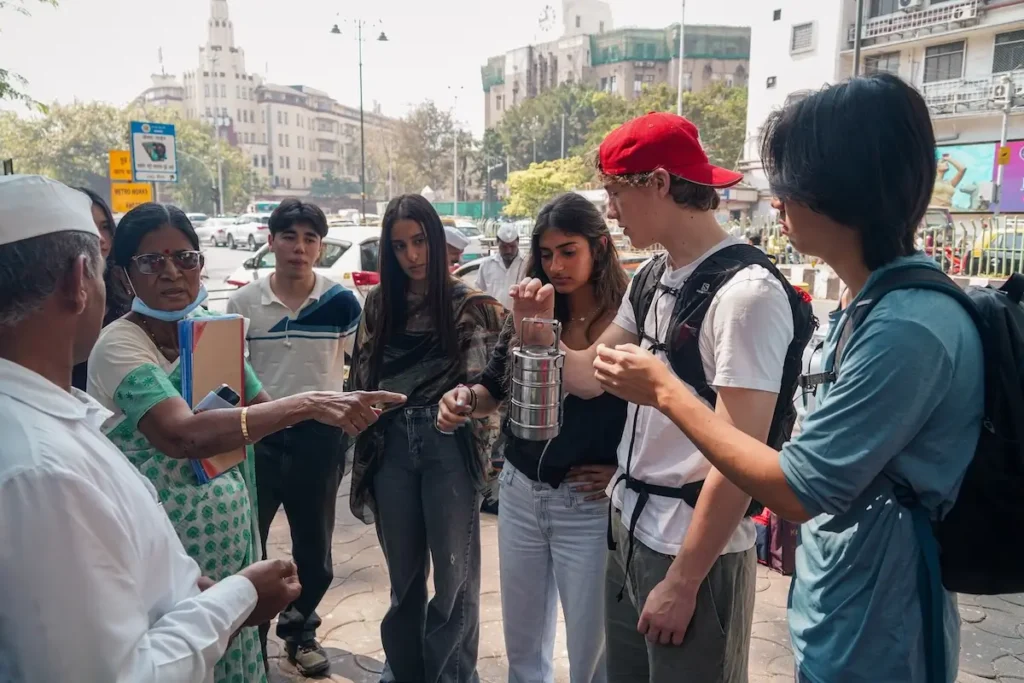
    • Dabbawalas: Studying the legendary lunch-delivery system provided a masterclass in logistics, loyalty, and near-perfect operational efficiency.

    Final Product: The ENpower Pitch

    The term culminated in a professional startup pitch (Navonmesa) delivered to industry mentors.

    • The Assessment: The duo presented a full business model, including a tiered subscription service (Standard and Pro+) and a B2B advertising strategy.
    • Refinement: Based on expert feedback, the final iteration focused on a “powerful” user hook and a clear bridge between transit data and consumer rewards, ensuring the business was both socially responsible and financially viable.
  3. Mobile App Development

    June 2, 2025 by Sarfo A.

    The Driving Question

    How can I design and create a mobile app for my NGO that allows us to educate people and easily engage followers and volunteers?

    The Project: Connecting Communities Through Code

    In response to his driving question, Sarfo developed a mobile application aimed at addressing digital isolation among youth in Ghana.

    Despite widespread access to smartphones and technology, many young people lack access to relevant, accessible information about their communities, their country, and the wider world. Sarfo identified this gap not as a lack of tools, but as a lack of connection.

    The Core Idea: His solution was to design an app that:

    • Shares curated news and global trends in a simple format
    • Promotes local and international events with accessible registration
    • Creates a digital hub for community interaction and knowledge sharing
    • Provides access to free learning resources and courses

    By using tools already present in users’ daily lives, the project focused on accessibility rather than complexity.

    Design, Development & Iteration

    Sarfo’s process followed a structured cycle of learning, designing, building, and iterating.

    Learning the System:
    He began by identifying his target audience, youth aged roughly 16–24 in Ghana, and researching the devices they use. This led him to select technologies that would allow cross-platform development for both Android and iOS within a limited timeframe.

    Designing for Impact:
    Through multiple iterations, Sarfo refined his UI/UX approach, moving from text-heavy, unclear layouts to a more intuitive and visually engaging interface. His design principles focused on simplicity, consistency, clarity, and efficiency, ensuring the app would be easy to navigate and meaningful for users.

    Building the App:
    Using React Native, he developed the app from scratch, managing authentication systems, data storage, and version control.

    Iterating Through Feedback:
    Sarfo created a structured feedback system using shared documents where testers could report issues and suggest improvements. This allowed him to continuously refine the app, addressing bugs, improving usability, and adapting features based on real user experience.

    Challenges & Breakthroughs

    The development process presented both technical and creative challenges.


    Technical Obstacles:
    Debugging complex code and resolving “mysterious bugs”
    Managing authentication systems
    Maintaining code stability and accessibility across devices


    Design Challenges:
    Translating ideas into clear, user-friendly interfaces
    Balancing functionality with simplicity
    Through persistence and iteration, Sarfo moved from early prototypes to a fully functional application ready for user testing, marking a significant milestone in both technical skill and problem-solving ability.

    Final Product: A Platform for Access

    The final app serves as a centralized platform where users can access news, events, and educational resources while connecting with their community.

    The Impact:

    • Increased awareness of local and global issues among youth
    • Strengthened community engagement through shared events and information
    • Improved confidence and access to opportunities for young users

    By transforming existing technology into a meaningful tool, the app begins to address the issue of digital isolation at its root.

    The Summative Reflection

    For Sarfo, this project extended beyond coding or technical development. It became a way to rethink access, equity, and the role of technology in everyday life.

    What started as a passion for programming evolved into a solution with real-world impact. Through this process, he not only developed technical expertise, but also a deeper understanding of how technology can bring people together.

    As he reflected, the goal was never just to build an app, but to ensure that young people are not left out simply because they lack access to information.

  4. So Much Coffee

    by Halca S.

    The Driving Question

    How can I develop my understandings on the global coffee industry and its local variations through primary & secondary research?

    The Project: Coffee as a Learning Journey

    In response to his driving question, Halca developed a multi-year body of work using coffee as a framework to explore global systems, culture, and identity.

    The Research Foundation: Beginning with a mastery project, Halca investigated five key areas: the history of coffee, production systems, seed-to-cup processes, producing countries, and the global coffee industry. Through over 20 secondary sources and primary café observations across multiple countries, he built a comprehensive understanding of coffee as both a cultural ritual and an economic force.

    Systems & Equity: Expanding on this foundation, he conducted a comparative research study on coffee trade systems in Ethiopia. By analyzing traditional commodity markets alongside certifications like Fairtrade and Rainforest Alliance, Halca evaluated their impact on smallholder farmers. His findings revealed that even systems designed to promote equity can carry bias, often highlighting success while overlooking limitations. This reflects core principles of industry analysis, where understanding both opportunities and constraints is essential.

    Production & Sustainability: Shifting focus to Brazil, Halca explored sustainable farming practices such as agroforestry and examined how land ownership and environmental systems shape coffee production. This work emphasized that innovation in coffee begins at the level of farmers and ecosystems, not just in cafés.

    Final Product: From Knowledge to Action

    The culmination of Halca’s learning extended beyond research into community impact.

    The Service Initiative: In Indonesia, he designed and led a coffee workshop for young adults from an orphanage, addressing gaps between education and employment. The workshop covered brewing techniques, flavor profiling, and coffee tasting, creating access to skills and new opportunities.

    The Reflection: Through this experience, Halca recognized that knowledge gains value when it is shared. Coffee became not only a subject of study, but a tool for connection, access, and empowerment.

  5. Fashion Sense

    March 9, 2025 by Zach H. and Nora W.

    Location: Hanoi, Vietnam | Term: 2024-2025

    The Driving Question

    How can traditional Vietnamese garments and fashion practices be reimagined through the integration of modern design, global influences, and ethical fashion business models?

    The Project: Vietnamese Fashion & Business Exploration

    In response to the driving question, Zach H. and Nora W. developed individual fashion-focused projects within a shared mentor group centered on fashion. While each pursued distinct creative directions, their work collectively explored the intersection of Vietnamese tradition, contemporary design, and ethical fashion systems.

    The Design Goal

    Working from a self-defined vision, the student aimed to create original fashion pieces inspired by traditional Vietnamese clothing, adapted to modern fashion culture.

    • Creative Direction: Designs blended Vietnamese traditional aesthetics with contemporary, global influences.
    • Production Process: The student collaborated with a local fashion house to manufacture garments, gaining hands-on experience in measurements, technical design, and communication with industry professionals.
    • Final Outputs: The project included a design portfolio, three completed garments, and a modeled photoshoot.

    Innovation & Ethics

    The project explored how innovation and ethics intersect within the fashion industry:

    • Sustainable Practices: Research into local production revealed the use of natural dyes and self-grown materials.
    • Transparency in Production: Through shared experiences with Zach H. and Nora W., the group examined how ethical brands prioritize openness and accountability.
    • Comparative Analysis: A research component highlighted structural differences between Western fashion industries and Vietnamese systems, with the latter often emphasizing environmental awareness and ethical production.

    Field Research & Immersive Learning

    To ground their projects in real-world context, Zach H. and Nora W. engaged in extensive fieldwork across Hanoi:

    • KILOMET109:
      A key experience where the group interviewed artisans who produce garments entirely from raw materials, including growing cotton and creating natural dyes, demonstrating a fully sustainable production model.
    • Chula Fashion:
      Visited by Zach H. and Nora W. this Spanish-Vietnamese fusion brand emphasizes inclusivity, employing a majority of staff with physical disabilities. Its open workshop model provided insight into transparency and ethical production.
    • Manufacturing Experience:
      Regular visits to a local fashion house allowed the student to oversee garment production and build practical industry skills.
    • Mentorship & Collaboration:
      Ongoing meetings with their mentor Sophie, alongside Zach H. and Nora W., supported iterative design development and critical reflection.

    Final Product: A Comprehensive Fashion Project

    • The Assessment:
      A completed design portfolio documenting the full creative process, alongside three original garments produced in collaboration with a local fashion house.
    • Academic Component:
      Completion of the Parsons School of Design Fashion Business Essentials course and a comparative research paper analyzing Western and Vietnamese fashion industries.
    • The Summative Reflection:
      The student reflected on the complexity of the fashion industry, particularly the range of choices surrounding transparency, cost, and ethics. The project challenged initial expectations, strengthened technical and professional skills, and ultimately affirmed a commitment to pursuing fashion in the future.

Sign up if you would like to receive occasional news from us.

Subscribe