Back
  1. Reimagining the Saree in India

    March 17, 2026 by Bernice M.

    Location: Mumbai, India | Term: 2025-2026

    The Driving Question

    How can traditional garments be reimagined through the merging of innovation and contemporary ethics with a deep-rooted history and culture?

    The Project: The Umushanana-Saree Fusion

    In response to the driving question, Bernice developed a bespoke saree design that acts as a cultural bridge between Indian textile tradition and her own Rwandan heritage.

    • The Design Goal: Working from a hypothetical client brief, Bernice sought to design a garment that felt “effortless and modern.” The result was a fusion concept inspired by the Rwandan Umushanana, reimagining the saree as a global garment suitable for high-profile celebrations like Rwandan weddings.
    • Innovation & Ethics: Her design process prioritized “slow fashion” ethics, researching sustainable materials like Tussar silk and examining how digital looms and CAD programs can modernize production without losing the “sacred geometry” of hand-drawn motifs.
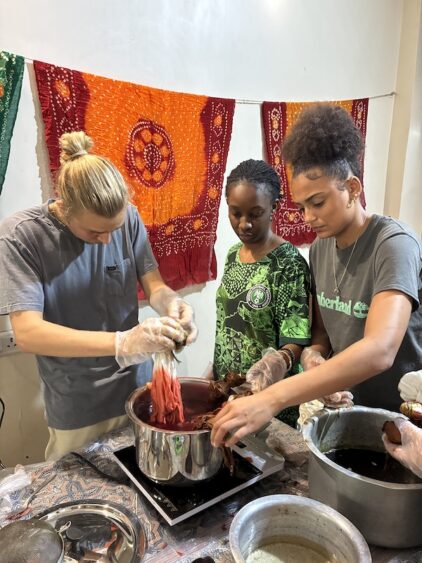
    Mastering the pinch: A close-up look at the precision required for Bandhani tie-dyeing, where small sections of fabric are bound to resist dye and create intricate patterns.

    Field Research & Immersive Learning

    To ground her design in “deep-rooted history,” Bernice engaged in extensive field research throughout Mumbai:

    • Sacred Geometry: By studying the Kanheri Caves and the Global Vipassana Pagoda, Bernice analyzed ancient architectural patterns—such as the Flower of Life—and translated those spiritual symbols into contemporary textile motifs.
    • Radical Resourcefulness: An excursion to the Dharavi informal economy provided a lesson in “contemporary ethics.” She observed how the community’s circular economy repurposes every scrap of fabric, proving that high-efficiency production can be deeply sustainable.
    • Technical Workshops: Bernice took part in hands-on learning in Bandhani (Tie-dyeing) and Block Printing, mastering the technical precision required to balance traditional complexity with a modern, “effortless” aesthetic.
    A high-angle shot looking down at a large, circular stone floor inside a grand hall. The floor features an intricate geometric star-shaped pattern made of inlaid stone. A person stands near the center of the design, providing a sense of the massive scale of the architecture. The space is part of the Global Vipassana Pagoda in Mumbai, visited during the Śāṭikā Sūtra module.

    Final Product: A Bespoke Design Brief

    The module culminated in a technical design for a 5,000-year-old garment reimagined for the 21st century.

    • The Assessment: Bernice produced a final design specification, including a client needs analysis and a structural breakdown of the saree’s Par (border) and Pallu.
    • The Summative Reflection: In her final analysis, she reflected on the ethics of cultural representation, arguing that the “Umushanana-Saree” is not just a piece of clothing, but a respectful evolution that celebrates diversity and the shared pride found in both Indian and Rwandan traditions.
  2. Mumbai Move: Rethinking Urban Mobility and Social Entrepreneurship

    March 7, 2026 by Ben B. and Liam F.

    Location: Mumbai, India | Term: Winter 2026

    Navonmesa Module Driving Question

    How might Mumbai’s community-driven systems inspire more sustainable urban living?

    The Challenge

    Mumbai’s congestion is more than a nuisance; it’s a crisis. Residents lose nearly half their personal time to traffic, and the resulting air pollution contributes to hundreds of deaths annually. With 19% of the population occupying 82% of the road space in private vehicles, the city’s productivity and safety are at a breaking point.

    The Solution: Mumbai Move

    Liam and Benjamin developed Mumbai Move, a service-exchange app designed to shift commuters from private cars to public transit.

    • How it Works: The app tracks bus and train journeys via Google Maps integration.
    • The Incentive: Users earn points based on mileage and time spent on public transport, redeemable for discounts at local businesses.
    • Impact: By gamifying sustainable travel, the project aims to reduce four-wheeled vehicle traffic by 10% and provide real-time carbon emission tracking for every user.

    Field Research & Inspiration

    The project was fueled by immersive experiences across Mumbai:

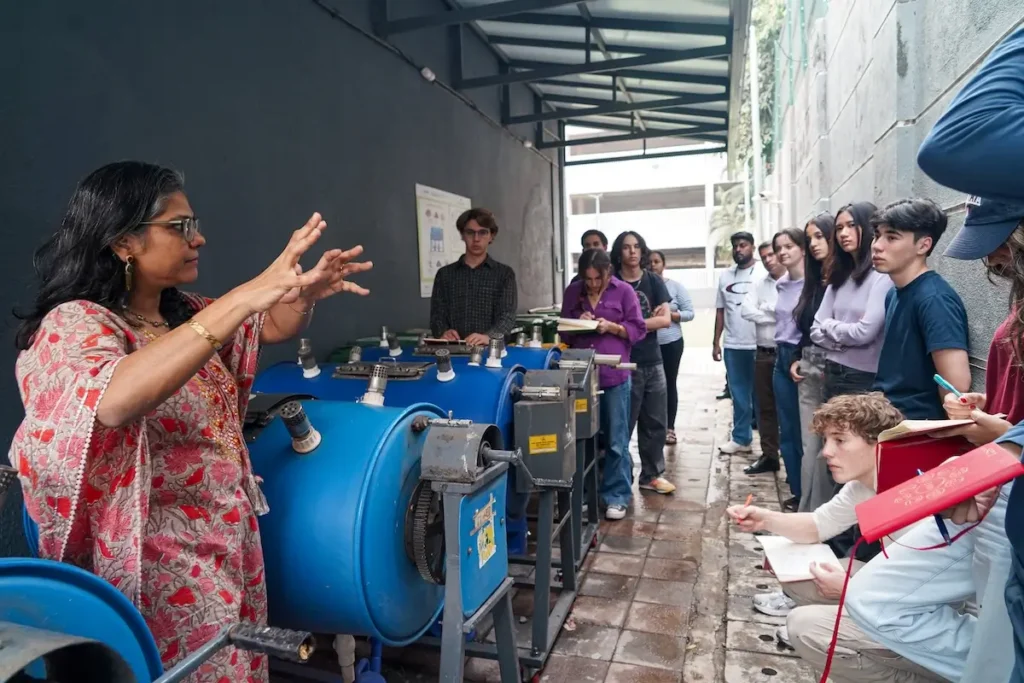
    • Dharavi: The team explored the “slum’s” $2 billion circular economy, learning how total resource efficiency and community interconnectedness can drive massive impact.
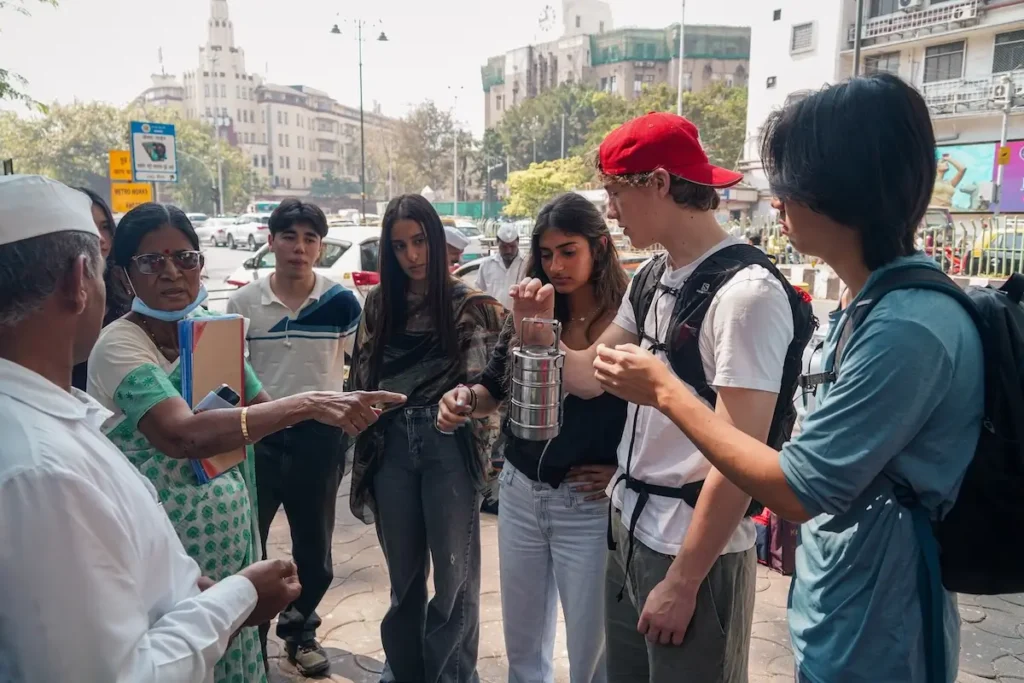
    • Dabbawalas: Studying the legendary lunch-delivery system provided a masterclass in logistics, loyalty, and near-perfect operational efficiency.

    Final Product: The ENpower Pitch

    The term culminated in a professional startup pitch (Navonmesa) delivered to industry mentors.

    • The Assessment: The duo presented a full business model, including a tiered subscription service (Standard and Pro+) and a B2B advertising strategy.
    • Refinement: Based on expert feedback, the final iteration focused on a “powerful” user hook and a clear bridge between transit data and consumer rewards, ensuring the business was both socially responsible and financially viable.

Sign up if you would like to receive occasional news from us.

Subscribe