
Location: Mumbai, India | Term: 2025-2026
The Driving Question
How can traditional garments be reimagined through the merging of innovation and contemporary ethics with a deep-rooted history and culture?
The Project: The Umushanana-Saree Fusion
In response to the driving question, Bernice developed a bespoke saree design that acts as a cultural bridge between Indian textile tradition and her own Rwandan heritage.
- The Design Goal: Working from a hypothetical client brief, Bernice sought to design a garment that felt “effortless and modern.” The result was a fusion concept inspired by the Rwandan Umushanana, reimagining the saree as a global garment suitable for high-profile celebrations like Rwandan weddings.
- Innovation & Ethics: Her design process prioritized “slow fashion” ethics, researching sustainable materials like Tussar silk and examining how digital looms and CAD programs can modernize production without losing the “sacred geometry” of hand-drawn motifs.
Field Research & Immersive Learning
To ground her design in “deep-rooted history,” Bernice engaged in extensive field research throughout Mumbai:
- Sacred Geometry: By studying the Kanheri Caves and the Global Vipassana Pagoda, Bernice analyzed ancient architectural patterns—such as the Flower of Life—and translated those spiritual symbols into contemporary textile motifs.
- Radical Resourcefulness: An excursion to the Dharavi informal economy provided a lesson in “contemporary ethics.” She observed how the community’s circular economy repurposes every scrap of fabric, proving that high-efficiency production can be deeply sustainable.
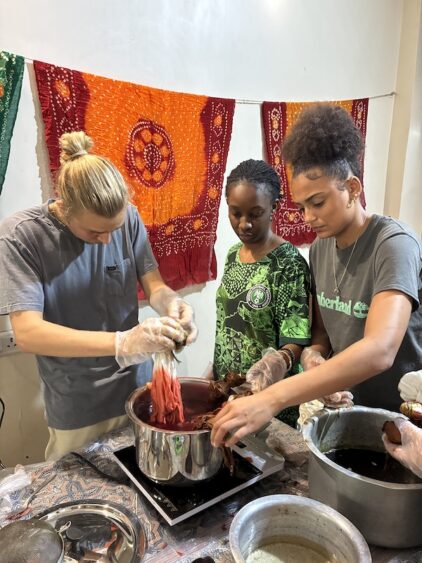
- Technical Workshops: Bernice took part in hands-on learning in Bandhani (Tie-dyeing) and Block Printing, mastering the technical precision required to balance traditional complexity with a modern, “effortless” aesthetic.

Final Product: A Bespoke Design Brief
The module culminated in a technical design for a 5,000-year-old garment reimagined for the 21st century.
- The Assessment: Bernice produced a final design specification, including a client needs analysis and a structural breakdown of the saree’s Par (border) and Pallu.
- The Summative Reflection: In her final analysis, she reflected on the ethics of cultural representation, arguing that the “Umushanana-Saree” is not just a piece of clothing, but a respectful evolution that celebrates diversity and the shared pride found in both Indian and Rwandan traditions.
